

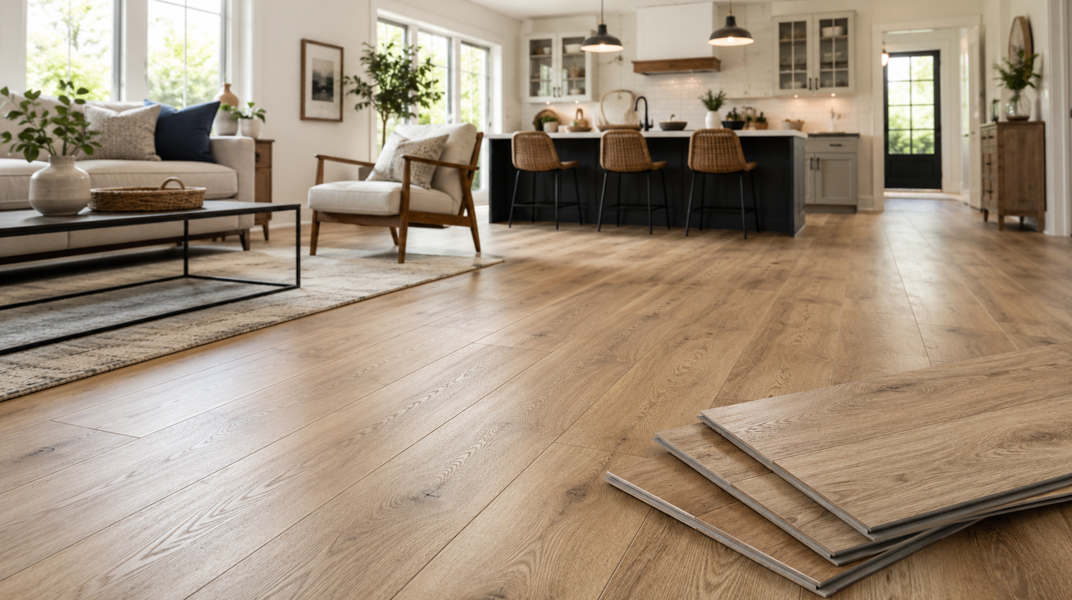
Laminate flooring has come a long way from the flat, repetitive designs many homeowners remember. Today’s better-quality products can reproduce the grain, color variation, knots, plank edges, and low-sheen finish of natural hardwood with impressive detail.
That realism does not come from color alone. Texture, edge treatment, plank dimensions, pattern variation, finish, and installation quality all influence whether laminate looks convincing once it covers an entire room.
This matters in Cedar Park and Leander homes, where open floor plans, large windows, active households, pets, and strong Central Texas sunlight can make every flooring detail more noticeable. A sample may look attractive in a showroom, but the final result depends on how its features work together under the lighting and daily conditions of your home.
As a family-owned flooring company serving Central Texas, Texas Flooring Professionals helps homeowners compare flooring based on appearance, performance, and the way each room is used. Rather than choosing laminate from a small color sample, it helps to understand the specifications that create a more authentic hardwood look.
Here is what to examine when you want laminate that looks natural instead of printed or overly uniform.
Start With the Printed Wood Visual
The decorative image layer gives laminate its wood species, color, knots, mineral streaks, and grain pattern. This is the feature homeowners usually notice first, but not every printed visual offers the same level of realism.
Some products use a limited number of plank images. When the same knot or grain pattern appears repeatedly across a room, the repetition can make the floor look manufactured. Products with greater visual variation are less likely to create an obvious pattern.
When comparing samples, ask how many unique plank visuals are included in the collection. Lay several full-length planks beside one another when possible. A single sample board cannot show how frequently a pattern repeats.
Look for Natural Color Variation
Real hardwood is rarely one perfectly consistent color. Even boards cut from the same species can vary in tone, grain direction, and character.
Realistic laminate often includes controlled variation between planks. This may involve:
Slight changes in color
Different grain patterns
Occasional knots
Mineral streaks
Light and dark areas within a plank
Variation between heartwood and sapwood effects
The goal is not maximum variation in every room. A contemporary Cedar Park home may look better with a clean, consistent white-oak visual, while a rustic Leander interior may suit a hickory or chestnut look with stronger contrast.
Choose variation that supports the home’s style rather than selecting the busiest pattern available.
Examine the Quality of Knots and Grain
Printed knots can reveal the difference between a refined laminate and a less convincing product. A realistic knot blends naturally into the surrounding grain. It should not look like a dark circle placed on top of the plank.
The same principle applies to grain lines. Real wood grain changes direction around knots and other natural features. Higher-detail visuals often reproduce these transitions more convincingly.
Stand back several feet and examine the sample as a whole. Then look at it closely. A strong design needs to work at both distances.
Texture Creates the Physical Sense of Wood
Texture is the surface pattern you can see and feel across a laminate plank. It adds depth and helps prevent the floor from looking like a smooth photograph.
Current laminate products may use wire-brushed, hand-scraped, sawn, rustic, or fine-grain textures. Manufacturers also offer products with embossed-in-register surfaces, where the physical texture follows the printed wood grain below it. Current Mohawk product specifications identify embossed-in-register construction in several laminate collections, while Shaw describes enhanced EIR texture as a way to make printed knots and grain physically noticeable.
What Is Embossed-in-Register Texture?
Embossed-in-register, often shortened to EIR, means the raised and recessed surface details are aligned with the printed design.
If the plank shows a knot, the texture may dip, rise, or change around that knot. If the visual includes a long grain line, the physical texture follows it rather than running in an unrelated direction.
This alignment creates a stronger sense of depth. Light catches the surface in a way that resembles real wood, and the floor can feel more authentic underfoot.
By comparison, a basic all-over texture may repeat the same surface pattern regardless of the printed grain. It can still add useful visual interest, but the effect may be less convincing when viewed closely.
Match Texture to the Wood Look
The most realistic texture is not always the deepest texture. It needs to make sense for the wood species and finish being represented.
A refined European oak look may suit:
Fine grain embossing
Gentle wire-brushed texture
A smooth matte finish
Limited scraping
Subtle pores
A rustic hickory or reclaimed-wood look may support:
Deeper grain
Sawn marks
Knots
Hand-scraped effects
More noticeable surface variation
A mismatch can weaken the illusion. Deep scraping on a clean, minimalist oak visual may feel exaggerated. A nearly smooth finish on a heavily rustic design may make the printed details look superficial.
Review Texture in Side Lighting
Texture is easiest to evaluate when light moves across the plank rather than shining directly down onto it.
Place the sample near a window and look at it from different angles. Cedar Park and Leander homes often have large windows and strong daylight, which can make surface texture, sheen, and repeating patterns more visible.
Check the plank in morning light, afternoon light, and artificial lighting when possible. A texture that looks subtle in a showroom may become more pronounced at home.
Also consider maintenance. Very deep textures can hold more dust in some settings, while completely smooth surfaces may show fine debris or footprints more readily. The right balance depends on household activity and cleaning preferences.
Beveled Edges Help Define Individual Planks
The edge profile determines how clearly one laminate plank is separated from the next. This detail can have a major effect on whether the finished floor resembles hardwood.
A square-edge plank creates a smoother, more continuous surface. A beveled plank has a shaped edge that produces a visible line or groove between boards.
Shaw explains that a standard beveled edge produces a more distinct line between planks, while a micro-bevel creates a subtler definition. Both are designed to strengthen the appearance of separate wood boards.
Square Edges
Square-edge laminate has little or no visible groove between planks.
This style may work well when you want:
A smooth overall surface
A clean contemporary appearance
Minimal plank definition
A more uniform floor
Easier removal of surface debris
However, square edges may not create the same individual-board appearance as beveled products. Small height differences or joint irregularities can also be more noticeable when the edges meet without visual separation.
Micro-Beveled Edges
A micro-bevel adds a fine line around the plank without creating a deep groove.
This can be a strong choice for homeowners who want:
Visible plank definition
A refined hardwood effect
Easier routine cleaning than a deeper bevel
A balanced contemporary look
Subtle shadow lines
Micro-beveled edges often pair well with light oak, natural maple, and other understated visuals. They define the plank while allowing the overall floor to feel calm and cohesive.
Standard or Pressed Bevels
A deeper bevel creates more obvious separation between planks. It can reinforce rustic, traditional, or wide-plank hardwood visuals.
Pressed bevel technology can shape the surface layer down into the plank edge, creating a more integrated transition from the face of the board to the bevel. Pergo and Shaw currently list pressed-bevel laminate products intended to create an authentic wood-plank effect.
Deeper bevels may suit:
Rustic oak looks
Hickory visuals
Farmhouse-inspired rooms
Wide and long plank formats
Floors with noticeable color variation
The tradeoff is that deeper grooves can collect more dust and fine debris. Homeowners with shedding pets, active children, or high levels of tracked-in Central Texas dust may prefer a shallower edge that is easier to maintain.
Look at the Color Inside the Bevel
The bevel itself needs to coordinate with the face of the plank. If the edge is too dark, too light, or visibly separate from the printed surface, it can create an artificial outline around every board.
Some manufacturing processes carry the design or color treatment over the edge to make the transition look more natural. Mohawk describes its GenuEdge process as extending the design over the plank edge while combining it with registered embossing for a more realistic appearance.
Examine the bevel from standing height, not only at close range. The edge should create definition without making the floor look striped.
Thickness Affects Feel, Stability, and Transitions
Laminate thickness is usually measured in millimeters or fractions of an inch. Current products vary considerably. For example, Pergo lists one laminate construction at 8 millimeters with an attached 2-millimeter pad, while current Shaw laminate listings include products around three-eighths of an inch and one-half inch thick.
A thicker plank can feel more substantial, but thickness alone does not determine quality or realism. Core density, locking-system design, surface construction, underlayment, subfloor preparation, and installation all contribute to performance.
Does Thicker Laminate Look More Like Hardwood?
Not automatically.
Thickness does not change the quality of the printed wood image or guarantee realistic texture. A thinner product with excellent EIR detail, natural pattern variation, and a well-designed bevel may look more convincing than a thicker product with a repetitive print.
Thickness can still support the finished experience by influencing:
The sense of solidity underfoot
Joint strength
Sound
Compatibility with attached padding
Floor height
Transitions to nearby materials
The ability to bridge minor subfloor texture within manufacturer limits
It is better to view thickness as one part of the full construction rather than as a simple quality ranking.
Compare Total Thickness Carefully
Some product labels separate the plank thickness from the attached pad. Others list total thickness. A plank described as “10 millimeters” may consist of an 8-millimeter board plus a 2-millimeter attached underlayment.
Ask whether the listed measurement includes the pad. This matters when comparing products and planning transitions to tile, carpet, hardwood, or existing floors.
Consider Doors, Cabinets, and Adjoining Rooms
A thicker floor can raise the finished surface enough to affect:
Door clearance
Appliance clearance
Stair nosing
Baseboards
Existing cabinets
Exterior doors
Transitions between rooms
These details are especially important in remodels where some flooring will remain in place.
A professional measurement and site review can identify where reducers, T-moldings, end caps, or other transition pieces may be needed.
Plank Width and Length Influence Realism
Plank dimensions affect how the floor reads across the room. Wide and long formats can create a spacious, upscale appearance, while narrower boards may suit traditional wood species or smaller spaces.
Current laminate collections show considerable variation in plank dimensions, including products around 5.25 inches, 7.5 inches, 9.25 inches, and wider. Some newer products also use longer boards to support an expansive hardwood look.
Wide Planks
Wide planks can work beautifully in open-plan Cedar Park and Leander homes. They reduce the number of visible seams and allow more of the printed grain to appear on each board.
They often complement:
Open kitchens
Great rooms
Contemporary interiors
Farmhouse designs
Large primary bedrooms
Long sightlines
However, width needs to suit the wood visual. An extremely wide plank printed with a species traditionally associated with narrow boards may feel less natural.
Narrower Planks
Narrower boards can add rhythm and detail. They may suit traditional interiors, smaller rooms, or designs inspired by older hardwood floors.
A narrower format also creates more seams, making bevel quality and installation alignment especially noticeable.
Long Planks and Pattern Repetition
Longer boards can create a calmer appearance because there are fewer end joints. They may also make rooms feel more expansive when laid along the main sightline.
The visual repeat remains important. A long board with an obvious repeated knot can be more noticeable because the feature covers a larger area.
When evaluating laminate flooring, compare several full planks rather than relying on a small sample. Look at the number of unique patterns, the position of knots, plank dimensions, edge treatment, and how the collection appears across a larger display.
Matte Finishes Usually Look More Natural
Sheen affects how light reflects from the floor. High-gloss laminate can emphasize the printed surface and may show footprints, dust, minor scratches, or repeated patterns more clearly.
Matte and low-sheen finishes generally create a softer, more natural look. They resemble many contemporary hardwood finishes and allow texture to provide depth without strong reflections.
Current Shaw laminate descriptions pair EIR textures with ultra-matte finishes to support more authentic oak visuals.
Think About Central Texas Sunlight
Direct sunlight can make a floor look lighter, warmer, or more reflective than it appeared in the showroom. It can also highlight seams, texture, dust, and gloss.
In rooms with large west- or south-facing windows, review samples during the brightest part of the day. Move them to different areas of the room and view them from the direction people will normally enter.
Window treatments can help manage glare and protect interior finishes, but product-specific care and warranty guidance still needs to be reviewed.
Coordinate Sheen Across the Room
The flooring finish does not need to match every surface exactly. Still, it helps to consider how it relates to:
Kitchen cabinets
Countertops
Painted trim
Furniture
Stair parts
Interior doors
Nearby tile
A matte floor may balance glossy countertops or painted cabinets. A floor with slightly more sheen may work in a formal space with polished finishes, provided it still fits the household’s maintenance preferences.
Color and Undertone Can Strengthen or Weaken the Wood Effect
A realistic floor needs a believable color story. Some laminate designs combine too many unrelated tones, making the surface feel busier than natural wood.
Look for an underlying direction such as:
Warm beige
Natural tan
Golden brown
Neutral brown
Taupe
Soft greige
Deep espresso
The plank may include several colors, but they need to feel connected.
Warm Tones for Cedar Park and Leander Homes
Warm oak, natural brown, and muted tan floors work well with many Central Texas interiors. They pair comfortably with white or cream walls, warm wood cabinets, black fixtures, stone countertops, and earthy textiles.
A warm floor can also make large open rooms feel more welcoming.
Use Gray Carefully
Gray laminate can still suit contemporary homes, but very cool or blue-gray options may feel less natural beside warm cabinets, beige stone, or cream walls.
Homeowners who like gray may prefer a balanced greige or weathered oak visual with warm and cool notes. This offers flexibility without creating a cold appearance.
Avoid Choosing From a Phone Screen
Online galleries are useful for narrowing the choices, but screens cannot represent flooring color reliably. Brightness settings, photography, surrounding décor, and image editing all influence what you see.
Physical samples provide a more dependable view. Place them beside permanent finishes and leave them in the room for several days before deciding.
Installation Quality Has a Major Effect on Realism
Even a beautifully designed laminate can look less convincing when the layout, subfloor preparation, or finishing details are poorly handled.
Installation affects joint alignment, pattern distribution, perimeter spacing, transitions, and the way planks meet walls, cabinets, stairs, and doorways.
Vary the Plank Patterns
Installers commonly work from several cartons to distribute light, dark, and repeated visuals across the room. Mohawk’s current installation guidance recommends selecting planks from multiple cartons to balance color variation and avoid grouping too many similar boards together.
Before a plank is installed, it can be checked for:
Repeated knots near another matching plank
Concentrated dark boards
Similar grain patterns
Visible defects
Unwanted color groupings
Careful distribution creates the irregularity expected from natural wood.
Stagger End Joints Naturally
End joints need to follow the manufacturer’s minimum stagger requirements. Beyond that, the layout can avoid obvious stair-step or “H” patterns that make the installation look mechanical.
Random-looking does not mean unplanned. The installer needs to balance visual variation with product requirements and efficient material use.
Prepare the Subfloor
Laminate floating floors require a subfloor that meets the manufacturer’s standards for flatness, dryness, cleanliness, and structural soundness.
High spots, low areas, debris, moisture, or movement can affect joint performance and the feel of the floor. Preparation may involve cleaning, patching, leveling, testing moisture, or addressing existing damage.
Laminate does not become more realistic simply because it is thick. A well-prepared foundation and correctly installed locking system help the floor feel stable and finished.
Finish the Perimeter Carefully
Baseboards, quarter round, door jambs, transitions, and stair components need to look intentional.
Common details that weaken the final appearance include:
Oversized transition strips
Poorly matched trim
Visible gaps
Awkward cuts around doorways
Repeated short boards near walls
Molding that clashes with the floor
These elements occupy a small part of the room, but they strongly influence the completed result.
A Practical Laminate Shopping Checklist
Before selecting laminate for a Cedar Park or Leander home, compare the full product rather than making the decision from color alone.
Review the following features:
Number of unique plank visuals
Realism of knots and grain
Embossed-in-register or all-over texture
Texture depth
Matte, satin, or gloss finish
Square, micro-beveled, or deeper beveled edges
Color continuity through the bevel
Plank thickness
Attached-pad thickness
Plank width and length
Water-resistance or waterproof claims
Room suitability
Wear and scratch warranty terms
Direct-sunlight guidance
Installation requirements
Cleaning instructions
Availability of matching trim
Recommended attic stock
Bring cabinet, paint, countertop, and fabric samples when comparing flooring. Photographs can help, but physical finish samples make undertones easier to identify.
It also helps to explain how the room is used. A household with large dogs, young children, rolling office chairs, or direct access to a patio may need different features from a quiet guest room.
Choose Features That Work Together
Realistic laminate is not defined by one specification. It comes from the relationship between the printed wood image, surface texture, edge profile, plank dimensions, finish, color variation, and installation.
For a refined modern look, you might choose:
A natural white-oak visual
Fine EIR texture
A matte finish
Micro-beveled edges
Wide planks
Moderate color variation
For a rustic interior, a stronger combination might include:
Hickory or character-oak visuals
Deeper grain
Visible knots
Pressed bevels
Longer boards
More pronounced variation
The best option is the one that looks believable in your lighting and supports the way your household lives. A sample that appears impressive on its own may not be the right choice beside your cabinets, furniture, or adjoining flooring.
Texas Flooring Professionals offers in-house design guidance, showroom appointments, and a shop-at-home service that brings samples to your door. To compare realistic laminate options in the actual light and surroundings of your Cedar Park or Leander home, reach out to us to schedule a flooring consultation or estimate.


